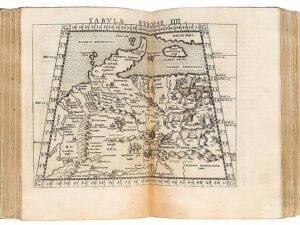
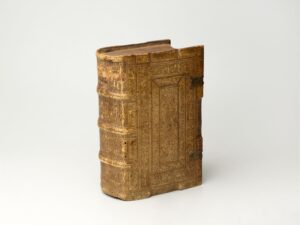
First edition of this important collection of surgical texts, selected and edited by Conrad Gessner, who also included his own treatise, De medicinae chirurgicae praestantia et antiquitate. The work can rightly be considered one of the earliest histories and bio-bibliographies of surgery and its key figures, encompassing around 150 authors — from Hippocrates to more recent names such as Guido Guidi, Jean Tagault, Jacopo Dondi, Mariano Santo, Angelo Bolognini, Michelangelo Biondo, Bartolomeo Maggi, Alfonso Ferri, Jacques Houllier, and Joachim Lang, among others.
The volume compiles authoritative ancient and contemporary sources on surgical techniques of the time, including amputations, the treatment of gunshot wounds, ulcers, gangrene, abscesses, tumors, fractures, and infected wounds. The woodcut illustrations — featuring skeletal anatomy, surgical instruments, and field surgery scenes — are derived from Vesalius, Gersdorff, and Guidi. Also included is a glossary of surgical remedies organized by pathology, mentioning, for example, the use of boiled cannabis for infected wounds and acacia gum to promote bone healing, the Balsamum anodynum Guidonis as a painkiller, the application of arsenic for wound treatment, and the antibacterial properties of lignum indicum, a Caribbean plant used against syphilis.
In the introduction, Gessner outlines the essential qualities of a good surgeon: a sound knowledge of anatomy, manual dexterity, a deep understanding of diseases, and mastery of technical terminology. In folios 393–408, he presents for the first time a concise bio-bibliographical survey of more than 150 authors in the history of medicine.
Conrad Gessner, a native of Zurich, was a quintessential Renaissance figure: physician, botanist, zoologist, Hellenist, bibliographer, prolific editor, and professor of philosophy. He studied classical languages and theology in Strasbourg, followed by medical studies in Bourges, Paris, and Montpellier. In 1537 he was appointed professor of Greek at the Academy of Lausanne, and from 1541 he resided in Zurich, where he practiced medicine. In 1546 he also began teaching physics, natural philosophy, and ethics. He died of the plague on December 13, 1565, at the age of 49 — a pulmonary form of bubonic plague, according to his own description.
In addition to the Chirurgia, Gessner was involved in three major intellectual undertakings: the Bibliotheca universalis (1545), which earned him the title “father of bibliography”; the encyclopedic Historia animalium (1551–1558); and the Historia plantarum (from 1541), a monumental herbal that he continued to work on until his untimely death.
Reference: VD16 G 1707 – Adams G 520 – Vischer K 32 – Wellisch 36,1 – Waller I, 1959 – Wellcome I, 1460 – Garrison-M. 5562 – Durling 960 – Osler 643 – Fischer, Gessner S. 86.