Description
NOVISSIMÆ HYSTORIARUM OMNIUM REPERCUSSIONES: QUÆ SUPPLEMENTUM SUPPLEMENTI CRONICARUM NUNCUPANTUR
Venice, Albertino da Lissona, 1503
Description
Folio (33×23 cm.), 445 leaves (of 452): leaves 299, 320, 359, 360, 373, 374, and 433 are lacking, the latter surviving only in its lower half. All missing leaves, including eight woodcuts, have been supplied in facsimile and either bound in or mounted onto the surviving portion of leaf 433.
Illustrated with a old hand-coloured woodcut coat of arms on the title page, four beautiful full-page and 87 old hand-coloured woodcuts of, mainly, city views (of 95, including repeats); first third of the volume with initials partially painted in red and rubricated by hand. The woodcuts retain their early decorative colouring; in the second half of the work, the colouring was executed by a later hand and the rubrication is no longer present.
The copy shows scattered waterstaining and light damp-wavering to the upper margin throughout much of the volume; the opening leaves are more heavily soiled and finger-marked from use. The paper is occasionally lightly browned, more noticeably around leaves 268 ff. and 287 ff., and with some minor staining. A few early marginal annotations are present.
The title leaf is more noticeably affected by dampstaining and soiling and is slightly loosened at the inner gutter at both head and foot. The final blank leaf is lacking.
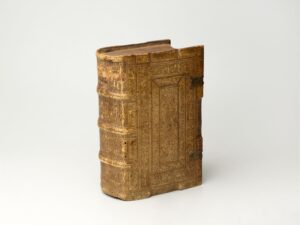
Contemporary blind-stamped pigskin over wooden boards, retaining two clasps. The binding shows some wear, rubbing, and staining; both covers exhibit a few minor wormhole defects and three old edge repairs. The front cover has a small loss of pigskin at the lower outer corner. Flyleaves lacking.
Comments:
Famous 1503 edition in splendid contemporary colouring and binding. The 1503 edition of Giacomo Filippo Foresti’s Supplementum chronicarum, published in Venice by Albertino da Lissona, ranks among the most significant editorial and historiographical achievements of the early Renaissance. In this revised version, the work was retitled Novissime historiarum omnium repercussiones.
The particular importance of the 1503 edition lies in the fact that it was the first book printed in Venice to contain an official account of the discovery of the New World and of Christopher Columbus’s voyages. Foresti devoted an entire chapter to the American discoveries (ff. 441–442), placing it under the year 1493.
Written in Latin, the text describes the geography of the newly discovered lands and the customs of the inhabitants of San Salvador, Hispaniola, and the other islands first visited by the explorers, becoming a key vehicle for the dissemination of knowledge and the emerging myth of America throughout Europe.
Compared with the first edition of the work, published in 1483 in fifteen books, the 1503 version was personally revised and expanded by the author. Foresti added a sixteenth book in order to update the universal chronicle with the events of the preceding twenty years, extending the narrative to 1499.
The 1503 edition is a masterpiece of Renaissance book illustration. It contains a remarkably rich woodcut apparatus, including large full-page illustrations depicting scenes from Genesis—the Creation of Eve, the Expulsion from Eden, the Death of Abel, and the Tower of Babel—as well as approximately ninety-five woodcuts, many of them animated city views. For this edition, the woodblocks used in earlier printings were largely reused, while a large and celebrated view of the city of Milan was newly introduced. The volume also includes an early and highly schematic representation of the world in the form of a geographical diagram.
Bibliography: EDIT 16, 19465; Adams F 748; Mortimer, 195; Essling 346; Sander 920; Alden-L. 503/2; Sabin 25083.